WaveLink
Choosing among China’s hot swappable transceiver suppliers takes more than comparing prices or browsing product photos. Buyers should check supported data rates, reach, connector types, power consumption, and compatibility with their network equipment. Small details matter. A module that fits physically may still require firmware checks or platform-specific testing.
Reliable suppliers can explain how they verify performance, manage quality, and handle failures after delivery. Ask for current datasheets, sample test reports, warranty terms, and clear answers about customization. If a supplier serves enterprise or data-center customers, request relevant experience without treating a client list as proof by itself. Ask for evidence. Practical evaluation can include testing samples under expected temperatures, workloads, and link distances before placing a larger order.
Price still matters, especially when projects require many modules. But an unusually low quote may leave important costs unclear, such as coding, shipping, replacement stock, or technical support. Compare equivalent specifications, not just headline prices. Also confirm lead times and how the supplier communicates design changes. A polished catalog is not proof of consistent production. That is easy to overlook. Even careful checks cannot remove every risk, and supplier claims deserve independent verification. This guide introduces ways to assess China-based suppliers and build a shortlist suited to your application, budget, and support needs.
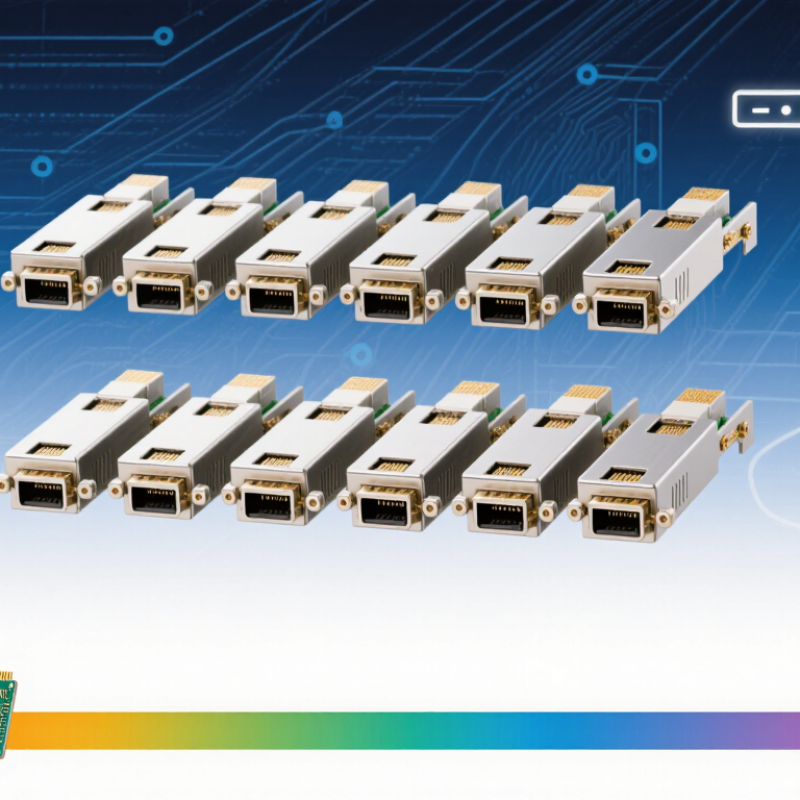
Hot-swappable transceivers are removable optical or copper modules that can be installed or replaced while network equipment remains powered. They fit into compatible switch or server ports, carrying data between the device and a cable. No shutdown is required.
When inserted, the host detects the module, reads its identification and operating information, then activates the port and establishes a link. A technician may see the process in status lights: module detected, link training, then a steady connection. The exact sequence depends on the host, module, and network settings.
The Ethernet Alliance’s 2024 Ethernet Roadmap tracks interfaces through 800GbE and 1.6TbE, illustrating rising bandwidth demands. IEEE 802.3df-2024 specifies Ethernet operation at 400 and 800 Gb/s. These figures describe link rates, not guaranteed application throughput.
Hot swapping also does not mean every module fits every port. Form factor, electrical interface, supported reach, and host configuration must match. For example, replacing an optical module without checking fiber type and distance can leave the link down. That detail is easy to miss.
Redundant links can reduce disruption during replacement, but a single-path connection may still lose service. In real deployments, compatibility records are sometimes incomplete; verify the host’s support information before handling a live port.
Which Standards and Specifications Matter When Choosing a Transceiver?
A hot-swappable transceiver must match the host port, not just the advertised data rate. Check its form factor, such as SFP, SFP+, or QSFP, and confirm the applicable multi-source agreement dimensions. Ethernet interfaces should align with the relevant IEEE 802.3 specifications. A plug that fits is not always a compatible module.
Match wavelength, fiber type, connector, and transmission distance to the installed link. For example, a 1310 nm module designed for single-mode fiber is not a safe substitute for a short-reach multimode unit. Check power limits and operating temperature too. Small details matter.
Ask suppliers for compatibility lists, production traceability, and test records covering transmit power, receiver sensitivity, and digital diagnostics. Digital monitoring can reveal temperature or optical-power changes before a link becomes unstable. Verify that reported values are supported by both the module and host equipment. On paper, a specification sheet may look perfect; firmware differences can still cause trouble in a live chassis. I have seen that detail overlooked. Request a sample for bench testing when possible, and check insertion, removal, and link recovery under normal operating conditions. Don’t rely on labels alone.
Representative IEEE 802.3 optical Ethernet standards compared by nominal data rate.
Data rates shown are nominal per Ethernet standard: 1GBASE-SX, 10GBASE-SR, 25GBASE-SR, 40GBASE-SR4, 100GBASE-SR4, and 400GBASE-DR4. When selecting a hot-swappable transceiver, also confirm the applicable IEEE standard, MSA form factor, host-port compatibility, wavelength, fiber type, connector, and required reach. Reach varies by standard and fiber grade; verify the specific product’s datasheet. DOM/DDM monitoring support may also be important for network operations.
China Best Hot Swappable Transceiver Suppliers?
How Can Buyers Evaluate Hot-Swappable Transceiver Suppliers in China?
Evaluating suppliers starts with checking whether their modules match your actual equipment and network needs. Confirm the required form factor, data rate, wavelength, connector type, and transmission distance. Request clear datasheets and ask how compatibility is verified across relevant switches or routers. Hot-swappable products should support installation or replacement without powering down compatible equipment, but system behavior can vary. Verify this with a sample and your own setup.
Look beyond the quoted price. Ask for test records, operating-temperature ranges, diagnostic monitoring details, warranty terms, and procedures for handling defects. A reliable supplier should explain product traceability and provide consistent technical support before and after purchase. Check whether sample results match the production specifications. A polished catalog is not enough; buyers can still overlook one small compatibility detail. I would not rely on verbal assurances alone.
Tips: Send suppliers the same written requirements, then compare their answers side by side. Test samples under realistic conditions, including link stability and temperature. Keep records of specifications and support responses. If an answer is vague, ask again. That extra step can save time later.
Supplier evaluation worksheet. The suggested weights are a buyer-created scoring model, not measured ratings of specific suppliers. Confirm specifications and certificates for each proposed product and application.
| Evaluation dimension | Suggested weight | What to check | Evidence to request or verify | Score (1–5) |
|---|---|---|---|---|
| Host compatibility and hot-swap behavior | 20% | Confirm the module form factor, port type, coding requirements, and operation in the intended switch, router, or server. Hot-swappable capability depends on the host design and supported configuration. | Written compatibility list, module datasheet, and a test in the actual host platform where possible. Confirm whether insertion or removal requires any host-specific procedure. | — |
| Standards and MSA alignment | 15% | Check that the offered optical interface and module type match the applicable IEEE 802.3 specification and relevant Multi-Source Agreement (MSA), where applicable. | Datasheet identifying the applicable interface, data rate, wavelength, fiber type, connector, and reach. Cross-check claims against the named standard or MSA specification. | — |
| Optical and electrical performance | 15% | Compare the specified transmit power, receiver sensitivity, link budget, wavelength, power consumption, and operating temperature with the requirements of the link and host. | Product datasheet with minimum, typical, and maximum values where specified; sample test results; and clarification of test conditions and measurement methods. | — |
| DOM / DDM monitoring | 10% | If required, confirm digital optical monitoring support and the host’s ability to read the module’s reported parameters, such as temperature, supply voltage, bias current, and transmit and receive optical power. | Datasheet and sample readings from the intended host or a suitable test system. Confirm which monitoring values and alarm or warning thresholds are supported. | — |
| Quality controls and traceability | 15% | Assess incoming inspection, production testing, final inspection, lot identification, and the process for handling nonconforming products. | Quality-process summary, sample inspection or test report, lot or serial traceability details, and any current quality-management certificates verified with the issuing body. | — |
| Compliance documentation | 10% | Identify the regulatory and material requirements for the destination market and the exact product configuration being purchased. | Applicable declarations and test documents, such as RoHS or REACH-related documentation when required. Check that documents identify the product or material scope and are current and relevant. | — |
| Warranty, returns, and technical support | 10% | Review the written warranty period, return authorization process, failure analysis procedure, response expectations, and support availability for compatibility issues. | Written warranty and return terms, escalation contacts, sample support response, and clear responsibility for shipping, replacement, and diagnostic costs. | — |
| Supply continuity and order terms | 5% | Evaluate quoted lead time, minimum order quantity, production capacity for the requested configuration, change-notification process, and shipment terms. | Written quotation, confirmed delivery schedule, order terms, and a process for approving specification or component changes. | — |
| Total | 100% | Weighted score = sum of (dimension score ÷ 5 × suggested weight). Use the same evidence and scoring rules for every supplier under review. | — | |
Scoring guide: 1 = inadequate or unsupported; 2 = significant gaps; 3 = meets basic requirements with evidence; 4 = strong evidence and fit; 5 = fully verified for the intended application. Treat missing or unverified documents as gaps rather than assuming compliance.
Chinese suppliers commonly offer pluggable optical transceivers across several form factors and data rates. Options often include 1G SFP, 10G SFP+, 25G SFP28, and higher-capacity QSFP modules for 40G, 100G, or faster links. Reach options range from short-reach multimode fiber to longer-reach single-mode fiber. Some catalogs also include copper RJ45 modules, DAC cables, and active optical cables. Availability varies by supplier.
Hot-swappable modules let technicians replace or install a unit without shutting down compatible equipment. Still, “hot-swappable” does not mean every module works in every switch. Check the host device’s supported form factor, speed, connector, wavelength, and reach. Digital diagnostics, such as temperature and optical power readings, can help with maintenance. Compatibility lists are useful, but they may not capture every firmware or configuration issue. The naming can be confusing, too.
Tips: Match the module to the actual link, not just the advertised speed. Confirm fiber type, distance, and connector before ordering. Ask for test reports or sample evaluation when deploying at scale. A lower-cost unit may be adequate, but verify performance under your network’s real conditions.
When comparing China-based hot-swappable transceiver suppliers, verify fit with the exact switch or router model, not just the advertised data rate. Check wavelength, reach, fiber type, connector, power limits, and host-device coding. A module that clicks into the port may still fail to link. Ask for a compatibility matrix and test samples in your own equipment before placing a large order.
Quality claims need evidence. Request test reports covering optical output, receiver sensitivity, error performance, and temperature range. Confirm whether digital diagnostics report temperature, voltage, and optical power accurately. Ask how production lots are traceable and what inspection happens before shipment. A polished datasheet is useful, but it is not proof by itself. I would not treat a broad compatibility list as a guarantee.
Tips: Test hot insertion and removal under your network’s approved procedures. Record link status, alarms, and traffic errors. Also check support response times, firmware or coding options, warranty terms, and replacement availability. Get these details in writing. If a supplier cannot explain a failed sample or provide clear test conditions, pause and reassess. One overlooked mismatch can cost more than a slightly higher unit price.
Match its form factor and data rate to the host port. A module that fits may still fail to link.
Match wavelength, fiber type, connector, and reach to the installed link. A 1310 nm single-mode module is not a safe substitute for a short-reach multimode unit.
Test it in your own switch or router. Check insertion, removal, link recovery, and stability under normal conditions. Labels alone are not enough.
Request results for transmit power, receiver sensitivity, error performance, and operating temperature. Ask how production lots are traced.
They can report temperature, voltage, and optical power. Confirm that both the module and host equipment support those readings. Small details matter.
No. A broad list is useful, but host coding or firmware differences may still cause trouble. I might be too cautious, but I would test the exact equipment.
Get warranty terms, defect procedures, replacement availability, and support response expectations in writing. Vague answers deserve a follow-up question.
Send each supplier the same written requirements, then compare specifications and test conditions side by side. Keep the replies. It helps later.
Hot-swappable transceivers let network operators replace or install optical modules without powering down the host equipment, helping reduce service interruptions and simplify maintenance. Choosing the right module involves checking the required data rate, reach, wavelength, fiber type, connector, power consumption, and operating temperature, as well as confirming that its interface and monitoring features match the host system. A hot swappable transceiver should be selected according to the application and the equipment’s documented requirements rather than appearance or price alone.
When evaluating suppliers in China, buyers can compare product range, manufacturing and inspection processes, customization options, delivery capability, and responsiveness to technical questions. Common offerings include modules for different speeds, distances, fiber types, and network uses. Before purchase, verify compatibility with the intended equipment, request clear specifications and test information, and review warranty terms, availability of replacement units, and after-sales support. Careful checks can help buyers balance performance, reliability, and cost.
